smartglassesBY REDGOLDExplore the system ↗

A COMFORT-FIRST DISPLAY STUDY

A different
point of view.

Keep the light and compute on the body. Shape the image near the eye. A research concept for adaptable, see-through displays and independently adjustable optics.

Optical research concept. Wearable packaging, visual comfort, image quality and complete-system eye safety are unresolved.

SPATIAL DESIGN STUDYDRAG TO ROTATE
Optical topology study: twelve local LCoS modules, two OLED paths and a source puck. Banks and layers are separated for clarity. This does not establish a slim wearable package or a surface-by-surface optical prescription.Optical topology study: twelve local LCoS modules, two OLED paths and a source puck. Banks and layers are separated for clarity. This does not establish a slim wearable package or a surface-by-surface optical prescription.
Optical topology study: twelve local LCoS modules, two OLED paths and a source puck. Banks and layers are separated for clarity. This does not establish a slim wearable package or a surface-by-surface optical prescription.
2 RGB banks/eyeseparate R, G & B channels
six local panels per eye
12illumination fibers binocular
before spatial modulation
1 OLED/eyea separate conventional image
with adjustable-focus optics

Keep the world visible.
Explore the light.Design intentions and planning values.
Not complete-system ratings.

THOUGHT IN EVERY INTERFACE

Put the work
where it belongs.

A body-worn puck handles sources, compute, battery and most cooling. Local optical engines give the light its spatial structure.

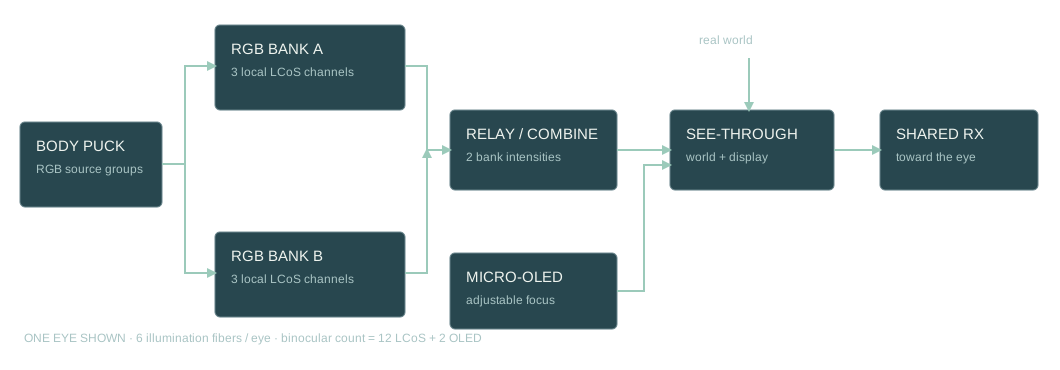
The current local-panel proposal uses two RGB LCoS banks per eye alongside a wide conventional micro-OLED image. A see-through combiner brings display and world light toward shared correction optics. Each optical path has a defined job—and an explicit evidence boundary.

THE ARCHITECTURE, OPENED UP

Follow the light.
Keep the paths distinct.

Illumination travels through fiber. Image-forming modulation happens on the glasses. This is the local-panel research proposal.

smartglasses functional architectureOne-eye functional diagram. Two RGB banks supply six local LCoS channels per eye; the OLED path is separate. The see-through combiner and shared prescription ordering follow the functional proposal; detailed surfaces and packaging are not frozen. Fiber does not carry an already formed image.BODY PUCKRGB source groupsRGB BANK A3 local LCoS channelsRGB BANK B3 local LCoS channelsRELAY / COMBINE2 bank intensitiesMICRO-OLEDadjustable focusSEE-THROUGHworld + displaySHARED RXtoward the eyereal worldONE EYE SHOWN · 6 illumination fibers / eye · binocular count = 12 LCoS + 2 OLED

One-eye functional diagram. Two RGB banks supply six local LCoS channels per eye; the OLED path is separate. The see-through combiner and shared prescription ordering follow the functional proposal; detailed surfaces and packaging are not frozen. Fiber does not carry an already formed image.

Carry the weight on the body.

Laser sources, regulated drivers, compute, battery and most cooling live in the wired puck. Two RGB source groups split toward the two eyes.

Six diode wavelengths do not mean twelve independently adjustable source powers. Exact source, power and cooling budgets remain open.

MADE CONCRETE

Look closer.
The details matter.

Reference dimensions and proposed interfaces make the concept tangible. Full packaging remains part of the design work.

LOCAL DISPLAY COUNT

12 LCoS + 2 OLED

Two RGB banks per eye, three local panels per bank. Optional DMD amplitude stages add routing and relays; they are not assumed in the baseline visual.

OPTICAL TARGET

10° × 6° initial field

Artificial-eye starting target with nominal 4 mm reconstructed pupil. These are proposed qualification targets, not achieved field, detail or eyebox ratings.

FIT REFERENCE

30 mm clear aperture

A prescription design reference, with 18–25 mm eye-relief exploration. Complete lens stack, frame outline and local-bank packaging remain unresolved.

OPEN ABOUT WHAT GOES INTO IT

Panel prices are a clue.
Not a complete optical channel.

USD component references, historical source snapshots and clearly visible gaps.

Twelve display-FLCoS module scenario$2,100–$3,060
Historical catalogue arithmetic · Oct 2026

Twelve × $175 HDMI modules or twelve × $255 prism bundles. FL09S is field-sequential display hardware; its listed price does not establish phase-only control or the required simultaneous RGB behavior.

Component source ↗
Qualified local phase panels & driversQuote needed
No selected compatible channel set

The HOLOEYE LUNA reference has specified phase modulation and 60 Hz normal input, but quote-only pricing and an external driver box. It is a qualification reference, not a selected wearable bank.

Component source ↗
OLEDs, relays & display combinersUnpriced
Exact configuration open

Two conventional image paths plus the holographic branch, polarization, RGB combining, order filtering and pupil-delivery optics.

Sources, fiber & body puckUnpriced
Exact configuration open

RGB illumination, splitters/coupling, twelve binocular feeds, source regulation, compute, power and cooling.

Prescription, frame & trackingUnpriced
Exact configuration open

Shared correction stack, per-eye adjustments, eye cameras, steering and stable mechanical datums.

DMD amplitude stages / world telescopeUnpriced
Independent options

DMD channels need real optical mappings; an optical world-view telescope is separate from digital zoom, OLED focus and prescription.

Download component references ↓

THE QUESTIONS WORTH ASKING

Behind
the concept.

Is this an ordinary waveguide display?

The current proposal starts with fixed reflective see-through combining optics. A waveguide remains a later coupler candidate. The unusual part is local programmable wavefront modulation alongside a conventional OLED path; a thin lossless waveguide is not assumed to solve the optical stack.

Does the fiber carry the hologram?

In this local-panel proposal the fibers deliver illumination before spatial modulation. The local LCoS engines then shape the wavefront. The separate remote coefficient/recorded-decoder research architecture uses a different tether and feedback model; its budgets are not combined with this one.

Can it change my prescription and give real optical zoom?

Manual per-eye correction and removable world-view telescope concepts are being explored as independent modules. Their adjustment limits, optical calibration, direct view and ray traces are not complete. Display crop, OLED focus and holographic depth are not the same as magnifying the real world.

How light, comfortable and ready is it?

There is no parts-backed complete weight, heat, power or cost total for the local twelve-panel configuration, and no integrated wearable result is documented. The visual is an optical layout study. Comfort is a goal; eye safety and an enclosed artificial-eye evidence program must be resolved before human use.

THOUGHTFULLY DESIGNED. OPENLY EXPLAINED.

A new view.
With every path explained.

Explore the assembly ↑